CIW’s response to Ahold: What is the company saying?

From the CIW’s website

April 22, 2011

Over the past year, the $40 billion supermarket conglomerate Ahold (Dutch parent company of US-based chains Stop & Shop, Giant, Martin’s, and Peapod), has issued a steady stream of corporate responsibility reportsopen letters, and public statements in an attempt to justify its decision to forgo participation in the CIW’s Fair Food Program. The program would require that Ahold agree to pay an extra penny per pound for the tomatoes it purchases, with that premium being passed on to the farmworkers who pick those tomatoes, and to purchase only from suppliers that adhere to a human rights-based code of conduct.

In an effort to defend its refusal to support the Fair Food Program, Ahold has offered up three basic rationales:

  1. Ahold claims that, according to its own internal audit, its Florida tomato suppliers meet its own Standards of Engagement. The results of this investigation thus guarantee that field workers in Ahold’s tomato supply chain are treated fairly and with dignity;
  2. While publicly praising last November’s breakthrough agreement between the CIW and the Florida Tomato Growers Exchange (FTGE), Ahold will not commit itself to the agreement’s benchmark standards nor will it pay the penny-per-pound price premium required by it. Instead, Ahold states that it will continue to pay a “fair market price” for its Florida tomatoes;
  3. Ahold claims that it “entered into a dialogue” with the CIW early in this process, implying that the course of action outlined in points (1) and (2) stems from a good-faith dialogue between the two parties.

Unfortunately for Florida farmworkers, Ahold’s unilateral approach stands in stark contrast to the promise of the Fair Food Program, a collaborative model of retailers advancing human rights in their supply chains, with their pennies and their purchases, that has been vetted and adopted by nine industry leaders – from the fast-food, foodservice and supermarket sectors – as well as by the FTGE.

Even the most casual analysis of the Ahold Standards of Engagement and the Fair Food Code of Conduct reveals striking and fundamental differences between the two approaches to supply chain accountability. In nearly all of its applicable provisions, the Ahold Standards of Engagement simply reaffirm compliance with existing legal norms and protections. The Fair Food Code of Conduct, on the other hand, establishes much higher standards that have been adopted through the direct partnership of buyers, growers and farmworkers themselves. This distinction is crucially important in the context of U.S. agriculture, where workers are excluded from the legal protections offered by the National Labor Relations Act and many sections of the Fair Labor Standards Act.

There are also major red flags around issues of verification and enforcement. The Ahold Standards of Engagement have no clear enforcement powers or investigative mechanisms.

What happens if a supplier is found to be out of compliance with the standards?

Who exactly will verify that Ahold follows through with its disciplinary procedures?

We’re simply left to take Ahold at its word. Under the Fair Food Code of Conduct, however, the taxonomy and consequences of code violations are clearly spelled out, as are the equally important mechanisms for independent, third-party verification and supply chain transparency.

All of which begs the question: How will Ahold even know if its suppliers are in or out of compliance with its own minimal standards?

The Florida tomato industry employs over 30,000 workers and cultivates over 30,000 acres across the state. Will Ahold dispatch its undisclosed and mysterious “internal team of experts” to Florida on a full-time basis to uncover human rights abuses in the fields? Or will Ahold sit back and wait for the occasional slavery prosecution or sexual harassment lawsuit to surface in newspaper headlines? Likewise, was Ahold “diligently monitoring” its tomato supply chain and “acting promptly and appropriately” when it continued, for months, to purchase tomatoes from at least one of the farms associated with a recent slavery prosecution? These questions are not rhetorical; they are essential to understanding the depth of Ahold’s commitment and the credibility of its approach.

The Fair Food Code of Conduct has been designed by farmworkers themselves, and its implementation and enforcement will likewise depend on ongoing farmworker participation. Under the Fair Food Code, workers play an indispensable role in promoting a safe and healthy workplace, maintaining their time records, and, when necessary, initiating a worker-triggered investigation process to uncover and address problems in the fields ranging from sexual harassment to verbally abusive supervisors. Workers are afforded no meaningful role in the Ahold Standards of Engagement, which is one of many reasons it will not improve conditions in Florida agriculture.

Finally, there are the issues of pay and price. The Fair Food Code of Conduct boosts farmworkers pay in two ways. Until now, it was standard practice for workers to have to overfill their buckets – which meant upwards of 10% of each worker’s labor was going unpaid. If they didn’t overfill the buckets, they would often not receive credit for the entire bucket. Now, farmworkers need only fill the bucket to the top in order for the bucket to be paid. Yet the Ahold Standards of Engagement are silent on this issue.

Likewise, the Fair Food Code of Conduct, through its penny-per-pound provision, has established a mechanism for retailers to improve farmworkers’ sub-poverty wages. To be clear, however, this does not require Ahold to enter into “direct wage negotiations” with farmworkers. As we have explained before:

“The penny-per-pound premium is, in fact, built into the final price, on the invoice, for the majority of retailers participating in the Fair Food program. The retailers simply pay for their tomatoes, as they always have, only now with a small premium, similar to any fair trade product. The accounting and distribution of the penny-per-pound funds are handled downstream in the supply chain. The workers are paid by the growers, in the form of a bonus in each check.”

Instead, Ahold has made clear that it simply wants to pay the straight market price. In reality, this means that Ahold will continue to use its high-volume, low-cost purchasing practices to demand ever lower prices for produce, creating ever stronger downward pressure on farmworkers’ wages and working conditions. In other words, Ahold’s Standards of Engagement simply offer more of the same when it comes to profiting from farmworkers’ exploitation. If Ahold truly supported social accountability within its tomato supply chain, it would make a real and binding commitment to the Fair Food Code of Conduct, including paying the penny-per-pound premium.

Which brings us to Ahold’s claim of a being engaged in a sincere and ongoing dialogue with the CIW, a claim they repeated at this week’s shareholder meeting in Amsterdam. In short, we beg to differ, and since we are supposedly the other half of this “dialogue,” we are in a unique position to do so.

Here is the sum total of Ahold’s dialogue with us: We have met with Ahold exactly twice — once, briefly, in Amsterdam, and once for about an hour in New York. The essence of their participation can be boiled down to this:Thank you for traveling here to share your thoughts with us, but we are not interested. Their attorney has spoken by phone with the CIW’s attorney twice since then to reiterate that message. The last call was five months ago.

There is no ongoing dialogue.

In short, Ahold continues its policy of, in the words of the National Economic and Social Rights Initiative (NESRI), “dragging its feet on farmworker justice in its supply chain and attempting to co-opt the good name of a leading human rights organization, the Coalition of Immokalee Workers (CIW), to cover its tracks.”

Yet none of this is news to Ahold. Its leadership knows whether we are engaged in a genuine “dialogue” or not, just as they know how real their “standards” are, or can be, without a modicum of enforcement, and how “fair” a market price is that drives ever-deepening poverty and degradation for the workers at the base of their supply chain.

Indeed, they know full well the reality behind their slick reports and position papers, but they choose to live in a world of quotation marks, of feigned engagement and cynical, superficial claims of social responsibility in their supply chain.

And they will remain in that world until they are obliged to abandon it and enter the real world, where the Fair Food Program is the highest ethical standard for sourcing tomatoes from Florida, where “Royal Dutch” Ahold finally catches up with the leaders of the oft-pilloried American fast-food industry in meeting those higher ethical standards, where turning a blind eye to human rights abuses in US fields is no longer a viable option for supply chain management.

Ahold will, sooner or later, be obliged to recognize the new reality. How soon depends on us – farmworkers and Fair Food activists – and our commitment to extending the Fair Food standards not only across the entire Florida tomato industry, but across the entire retail food industry that buys Florida tomatoes.

Because there is one thing about Ahold you can trust, and that is this: They will not abandon their world of social-responsibility-between-quotation-marks of their own volition.

Royal Ahold: the CIW goes to Amsterdam!

“Royal” Ahold sticks to company line at 2011 shareholders meeting in Amsterdam;
CIW responds…

The CIW’s Lucas Benitez crossed the Atlantic this week to attend Ahold’s 2011 shareholders meeting in Amsterdam. He went in the hope that, given a chance to make his case to the company’s board and the gathered shareholders, a more sincere dialogue might be sparked and Ahold could finally bring its US chains (Stop & Shop, Giant, Martin’s, and Peapod) in line with the Fair Food principles.

He joined forces in Amsterdam with representatives of the United Food and Commercial Workers (UFCW) and the Teamsters, both of whom brought their own serious grievances to the board about Ahold’s efforts to, in their respective cases, prevent workers from organizing in its stores and to eliminate good union jobs in its distribution network. The flyer in the picture above was part of a “goodie bag” assembed by all three workers’ organizations and distributed to all the shareholders as they arrived for the meeting.

When the time came for questions and answers, Lucas (shown below addressing the board members, with translation by Marc Rodrigues of the Student/Farmworker Alliance) asked two questions of the board chairman, Mr. Dahan:

“Does Ahold pay a fair trade premium on the fair trade products it sells in its stores? If the response is “yes,” why does Ahold refuse to pay the Fair Food premium for tomatoes that it says come from CIW certified growers?How can Royal Ahold justify that American fast-food companies like Mcdonald’s, Burger King, and Subway are, by any objective measure, meeting higher ethical standards in their tomato supply chains than Ahold, including paying a premium for fairer wages and committing their purchases in support of higher standards?”

But Royal Ahold (which, like the oil and gas company “Royal Dutch Shell,” was given its regal title by the Dutch royal family for its centenary in 1987) once again refused to engage in any sincere examination of its Florida tomato supply chain. Instead, clearly flustered by the Fair Trade question, the company talked about its “ongoing dialogue” with the CIW, insisted that Ahold only wants to pay “fair market prices,” and, despite the fact that both Lucas and Marc had traveled thousands of mile to be there, essentially read from the PR response to the Campaign for Fair Food on their website to round out their answer.

[If you have five minutes, it’s really worth watching the exchange, which you can find here. That link will take you to the Ahold shareholders meeting site. Once there, click on the “video broadband stream” link and move the time line to the 70:06 mark for the beginning of Lucas’ questions. The confusion and evasion around the Fair Trade analogy — captured to a degree in the expression on the face of Ahold’s board chairman, Rene Dahan, shown here on the right — are really something to see.]
As it happens, we have just now completed our trilogy of CIW responses to supermarket public relations position papers on the Campaign for Fair Food. You’ve seen our point-by-point response to Publix’s “put it in the price” defense, and our answer to Trader Joe’s “note to our customers about Florida tomatoes.”

Now, timed nicely with Ahold’s icy — and disappointingly disinguenuous — performance at the shareholders meeting, comes our response to Ahold’s “Letter to the CIW“. Here’s an excerpt, on the question of Ahold’s claim to an “ongoing dialogue” with the CIW:

… Which brings us to Ahold’s claim of a being engaged in a sincere and ongoing dialogue with the CIW, a claim they repeated at this week’s shareholder meeting in Amsterdam. In short, we beg to differ, and since we are supposedly the other half of this “dialogue,” we are in a unique position to do so.Here is the sum total of Ahold’s dialogue with us: We have met with Ahold exactly twice — once, briefly, in Amsterdam, and once for about an hour in New York. The essence of their participation can be boiled down to this: Thank you for traveling here to share your thoughts with us, but we are not interested. Their attorney has spoken by phone with the CIW’s attorney twice since then to reiterate that message. The last call was five months ago. There is no ongoing dialogue.

In short, Ahold continues its policy of, in the words of the National Economic and Social Rights Initiative (NESRI), “dragging its feet on farmworker justice in its supply chain and attempting to co-opt the good name of a leading human rights organization, the Coalition of Immokalee Workers (CIW), to cover its tracks.”

Yet none of this is news to Ahold. Its leadership knows whether we are engaged in a genuine “dialogue” or not, just as they know how real their “standards” are, or can be, without a modicum of enforcement, and how “fair” a market price is that drives ever-deepening poverty and degradation for the workers at the base of their supply chain.

Indeed, they know full well the reality behind their slick reports and position papers, but they choose to live in a world of quotation marks, of feigned engagement and cynical, superficial claims of social responsibility in their supply chain.

And they will remain in that world until they are obliged to abandon it and enter the real world, where the Fair Food Program is the highest ethical standard for sourcing tomatoes from Florida, where “Royal Dutch” Ahold finally catches up with the leaders of the oft-pilloried American fast-food industry in meeting those higher ethical standards, where turning a blind eye to human rights abuses in US fields is no longer a viable option for supply chain management.

Ahold will, sooner or later, be obliged to recognize the new reality. How soon depends on us – farmworkers and Fair Food activists – and our commitment to extending the Fair Food standards not only across the entire Florida tomato industry, but across the entire retail food industry that buys Florida tomatoes.

Because there is one thing about Ahold you can trust, and that is this: They will not abandon their world of social-responsibility-between-quotation-marks of their own volition.

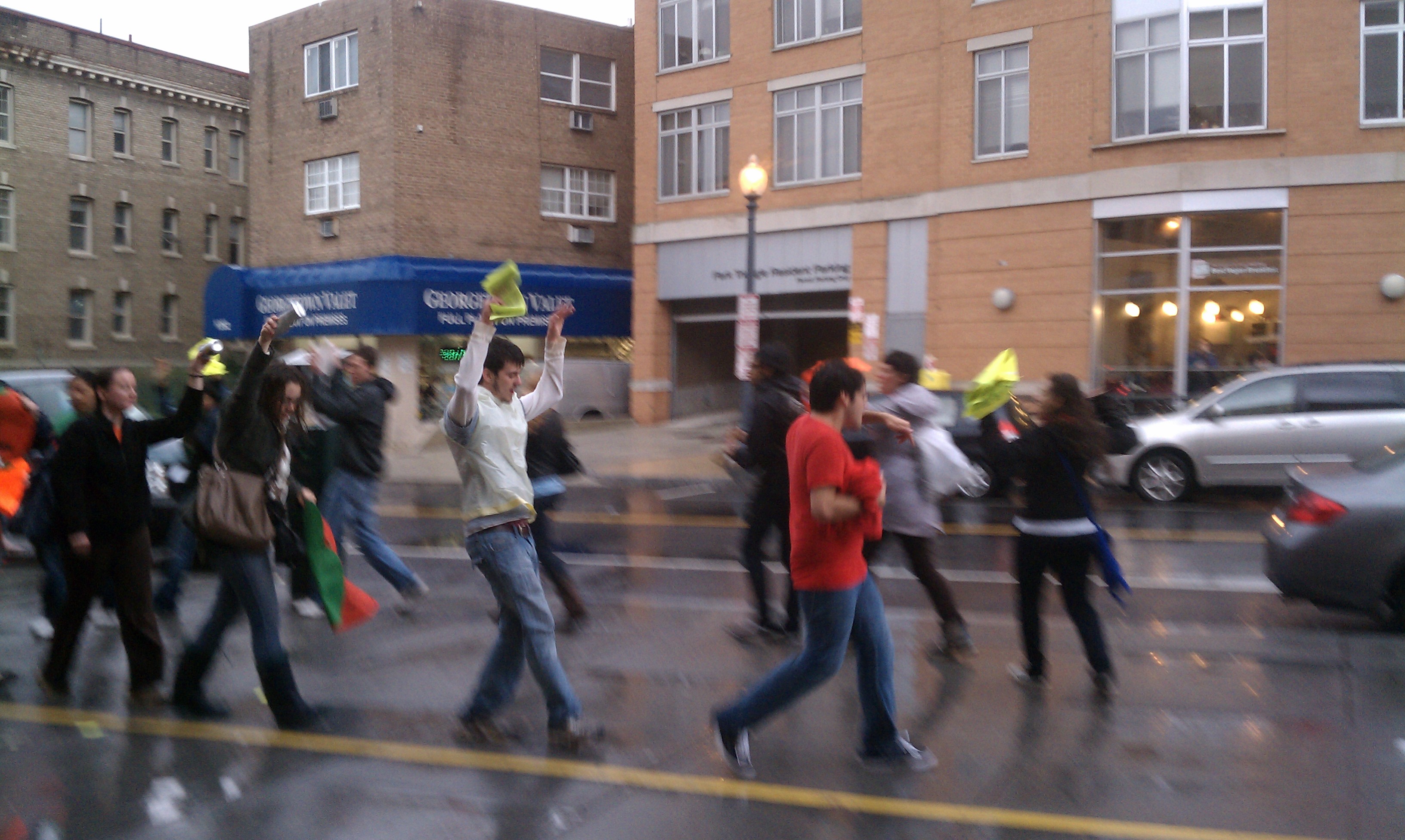
rain or shine, DCFF + allies celebrate D.C. Emancipation Day with a Giant picket!

In spite of inclement weather, D.C. Fair Food joined up with Power Shift allies today to ask Giant Food — and its parent company, Ahold USA — to join the Campaign for Fair Food! On April 16 in 1862, President Lincoln emancipated the slaves of Washington, D.C. Today, we commemorated this momentous decision to reject the notion that labor exploitation, especially in agricultural industries, is an acceptable building block of our food system. In order to build this re-visioning of the country, there is much more work to be done!

Keep an eye out for an action video from today and for the upcoming post card action across the country!

Directions to Emancipation Day Demonstration at Giant

Map and Directions


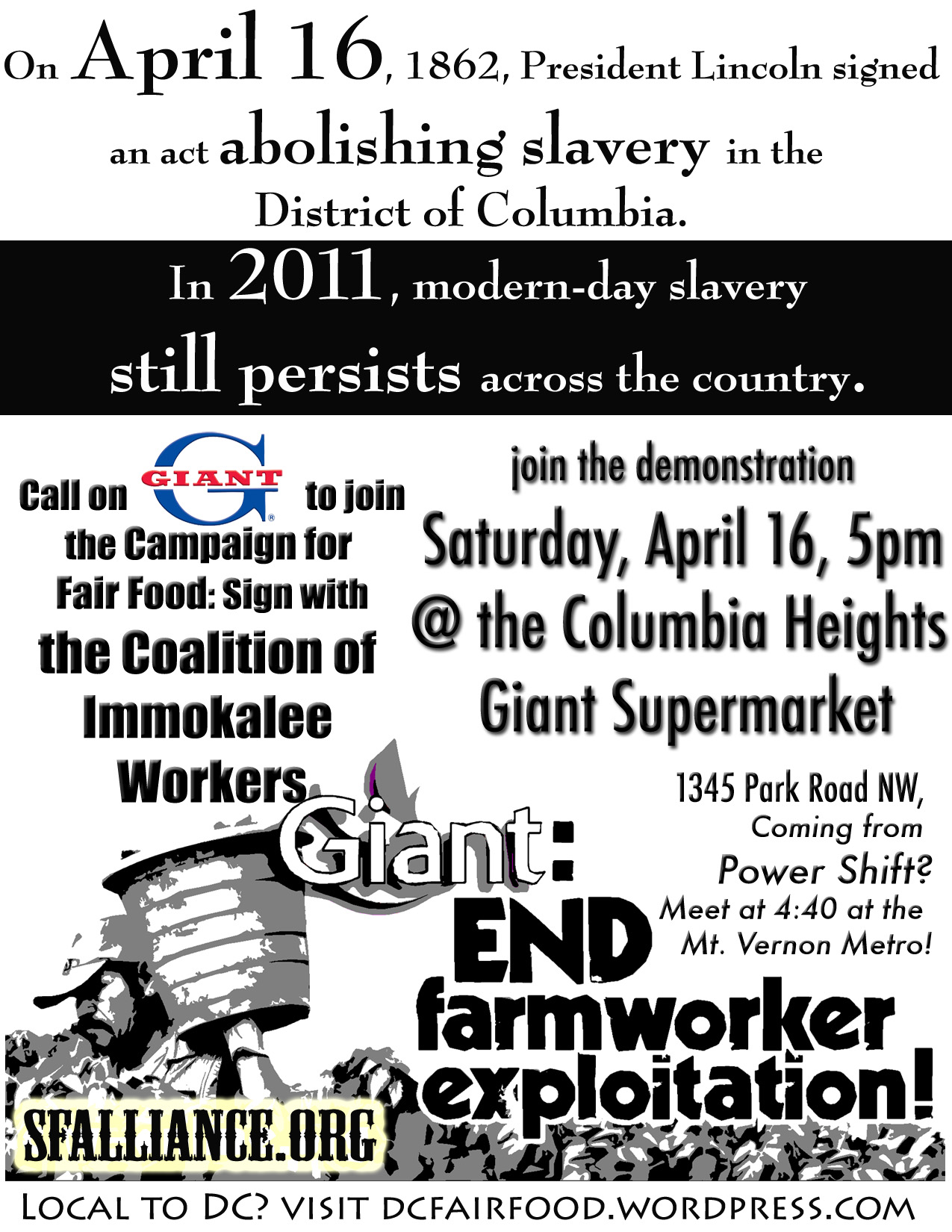
Join us at 5pm Saturday, April 16th at the Columbia Heights Giant  for a demonstration and discussion, and then we’ll head over to Haydee’s  for dinner! The closest metro stop is Columbia Heights on the green and yellow lines.

If you’re coming from Powershift  , meet at 4:40 at Mount Vernon metro stop and we’ll take the green or yellow line towards Greenbelt or Fort Totten to Columbia Heights.
April 16: Emancipation in 1862, but not 2011?

It’s time for the supermarkets to get on board with the Campaign for Fair Food, and build towards a world in which slavery is truly over.

In spite of support from nine other major buyers of tomatoes in the U.S. — including Ahold USA’s competitor Whole Foods, another major supermarket — Ahold USA refuses to work with the CIW in their efforts to combat well-documented exploitation of farmworkers. Almost 150 years ago, President Lincoln emancipated slaves in the District of Columbia in the midst of a long civil war that centered around the question of whether or not human beings were meant to be exploited and abused in the name of the profit of others.

The answer to that question was NO in 1862, and it is still NO in 2011.

April 4 Action: Tell Ahold USA to sign with the Coalition of Immokalee Workers!

Sign the online petition asking Ahold USA to join with the CIW, and send it to your friends!

In 1996, after a 17-year-old tomato picker was brutally beaten by his supervisor for stopping to get a drink of water, workers in Immokalee declared at the ensuing protest, “golpear a uno es golpear a todos” — if you beat one of us, you beat all of us.

It’s in that spirit of solidarity we call on D.C. area allies to the Fair Food Campaign to support our petition, to be delivered to Ahold USA on the April 4 Day of Action that is being organized by dozens of student, labor, faith, and civil rights organizations across the country.

On April 4, 1968, Dr. Martin Luther King Jr. was assassinated in Memphis, where he had gone to stand with sanitation workers demanding their dream: The right to bargain collectively for a voice at work and a better life.

Join us in solidarity with working people across the country who are fighting against the right-wing attack and for the rights Dr. King gave his life for: the freedom to bargain, to vote, to afford a college education and justice for all workers.

Today, shamefully, in Florida, Wisconsin, Ohio, Indiana, New Hampshire, Tennessee, and elsewhere, politicians and the corporations who funded their election campaigns are taking extreme steps to undermine workers’ basic rights.

In this national climate of anti-worker sentiment, it is even more critically important for companies like Ahold to take the lead on businesses that support the families of working America. Join us in calling on Ahold USA, a major supermarket in the United States, to join communities from across the country who affirm an America that lifts up the rights and dignity of all of its workers!

“He who passively accepts evil is as much involved in it as he who helps to perpetrate it.” – Dr. Martin Luther King, Jr.
in solidarity,
the D.C. Fair Food crew
Also, Find an action in your area to join on April 4th!

Giant Delegation Reportback!

With a delegation of students and local allies from the labor movement, the sustainable food movement, and communities of faith, D.C. Fair Food joined the CIW on their Do the Right Thing Tour to tell Ahold USA at their HQ in Landover, MD, that they need to step up as a leader in the supermarket industry and sign an agreement with the CIW!

Check out the video on our Media! page and the photo essay below…

Day Three Update
Delegation Visit to Giant Headquarters
Landover, MD
March 1, 2010


Another day, another delegation of farmworkers and allies turned away by a supermarket industry leader. 

This time it was the mid-Atlantic retail food chain Giant (one of Ahold’s principal properties here in the US along with Stop & Shop) …


… that turned down the CIW’s offer of dialogue, using these two guys to convey the message that nobody at Ahold wanted to meet with the CIW delegation.

Day Three of the Do the Right Thing Tour — a day that opened on a crisp, clear morning, much welcome after 48 hours of snow and rain — brought the CIW to the doorstep of the company’s headquarters in a nondescript corporate park near Landover, Maryland. 

The delegation, led by three CIW members (who appear on the left in this photo), included representatives from the local Presbyterian Church, labor (the Teamsters, who are organizing a sector of Giant’s drivers), the National Family Farm Coalition, and students from various local universities.


But despite the diversity and commitment of the delegation members, Giant executives would have none of their offer of an informal, informational meeting. 

This, of course, didn’t sit well with the rest of the CIW crew, who broke out in protest following the delegation’s rejection at the hands of Giant’s security.


With Giant’s headquarters as their backdrop, CIW members and their allies brought their call for a fairer, more humane food industry…

… to the otherwise lifeless corporate park.

As if inspired by the company’s cold silence and the challenge of the sterile setting, one CIW member launched into an impromptu theater, turning the neatly landscaped shrubbery…

… into a version of his own office, a tomato field in Immokalee. He was soon joined by another worker, who assumed the role of the field boss, and together they brought the daily abuse and humiliation faced by the people who pick tomatoes in Florida’s fields vividly to life. 

And in that moment, those gathered for the protest witnessed a most remarkable buckling of space and time: The Florida fields that for decades have provided a steady supply of tomatoes for Giant produce aisles in Maryland, Virginia, Delaware, and the District of Columbia suddenly and incongruously came to collide with the distant corporate headquarters that, for all those years, has played such an influential role in the lives of the farmworkers who picked those tomatoes.


The virtual reality of the improvised theater prompted the delegation members to hold their own virtual meeting with Giant executives…

… with allies and workers telling Giant — or, rather, the bricks and tinted windows that stood-in for company representatives — the messages they would have conveyed had they been able to go through with the meeting.

Santiago Perez of the CIW spoke of the hard-fought advances underway today in the fields — of higher wages, more humane work hours, and the end of the decades-old demand that workers overfill their buckets — and of Giant’s inexcusable abdication of its responsibility to contribute to those advances…

… while Julia de la Cruz, also of the CIW, spoke of the challenges faced by women forced by circumstances to seek a living harvesting tomatoes, challenges that include the constant threat of sexual harassment and the more subtle tyranny of unreachable production quotas.

After just under an hour, the Do the Right Thing crew wrapped up the action and left Giant’s headquarters without so much as a sign of life from the supermarket behemoth. 

But as they began to walk back to the bus to continue their way south, one of the workers noticed a small, hand-written sign in the window of the building immediately adjacent to Giant’s offices. Behind the sign could be made out a figure, someone that appeared to be waving at the departing workers.


The crew stopped in its tracks for a closer look. 

And, to the amazement of all, the message — pressed mutely to the tinted window of the brick building that looked identical in almost every way to every other building in the vast corporate park, including that of its neighbor, Giant — said:

Justice

A worker — a person with a heart and a mind of his or her own — saw the CIW workers and their rejection at the hands of Giant, stopped whatever it was they were doing, grabbed a piece of office paper and a company issued marker, and wrote out an urgent message of love for the farmworkers locked out of the offices that have profited so richly from their labor for so long.

And just like that, the facade of cold, uncaring power that Giant sought to project fell away, revealing the humanity on the other side of the opaque glass and brick walls. With one intensely human gesture, all the strength was stripped from Giant’s stony silence.

Yes, the person who sent the message doesn’t work for Giant, but that doesn’t matter. Both we and the executives who run Giant know — and this sign confirms — that human beings seek justice, and that circumstances of stark injustice are, sooner or later, unsustainable.

The change that workers in Immokalee have sacrificed so much for is going to come. And Giant will be a part of that change. Because human beings run Giant, too.


For more on the CIW visit to Giant headquarters: 

Boston Action Reportback!

D.C. Fair Food took a bus full of students from Georgetown University’s Georgetown Solidarity Committee, Georgetown Washington University’s Progressive Student Union and Students for Fair Trade, and American University’s MEChA group as well as a representative from Washington D.C.’s Union de Trabajadores to Boston for the biggest action the CIW has ever done in the Northeast! Check out the photo essay below, and the video in our Media! page above!


March on Stop & Shop
Boston, MA
Feb. 27, 2010


After two long days and 1,500 miles on the road, the Coalition of Immokalee Workers landed in Boston and brought its message of respect for fundamental human rights to the town where the American Revolution was born.

Waking up to a wintry scene with several inches of newly fallen snow on the ground, the marchers didn’t know what to expect when they arrived at historic Copley Square in downtown Boston. They were greeted, however, by hundreds of supporters from throughout the Northeast who were undeterred by the frigid weather.

Despite the intense cold and a snow that continued to fall throughout the day, the crowd grew steadily over the course of the hour-long rally, which featured several local speakers, including several religious leaders from the greater Boston area, and a few national leaders, too, including Frances Moore Lappe (author of “Diet for a Small Planet”) and Josh Viertel of Slow Food USA.

The rally also featured the debut of a young man whose mother — the Rev. Noelle Damico of the Presbyterian Church U.S.A. – needs no introduction on this site. On this day, August brought his own simple, two-word message of justice for the marchers gathered outside Boston’s historic Trinity Church:
Be Fair.

His message captured the spirit of the rally, which overflowed with the joy of fighting for simple justice…

… justice that became even more clear and stark for the crew from Immokalee — shown here leading the crowd out of Copley Square to begin the march — as the proximity to Stop & Shop’s nearby corporate headquarters heightened the sting of the company’s inexcusable refusal to join the Fair Food program.

Behind the CIW contingent followed our very own marching band, the Rude Mechanical Orchestra out of New York City, who provided rhythm and spirit throughout the march.

The march took to the streets…

… with some messages well-known and timeworn to those familiar with the Campaign for Fair Food…

… and others new to the campaign, like this one, pictured as the march passed the foot of Boston’s John Hancock Tower, that should serve as a cautionary note for the decision-makers at Stop & Shop and its $40 billion parent company Ahold.

The march wound its way through town toward Brigham Circle…

… growing as it went…

… with animo provided by Romeo Ramirez of the CIW, who spent the past several weeks in Boston and New York City organizing in advance of the march (and who spent most of the march itself on the sound truck)…

… and documented by a fresh new CIW media crew who pulled out all the stops in their efforts to capture the perfect angle on the day’s activities. (You can check out their handiwork — in the form of a great video short from the march — by clicking here!)

People in the street received the march with open minds…

… and open hearts. These people composed their own impromptu message of support — “Si se puede” — on their computer which they shared with the marchers passing by their streetside coffee shop perch. (While difficult to make out, if you look closely, you can see the words of the message on the computer screen and on the paper to the left.)

The march entered the final stretch, passing into…

… and out of a busy underpass…

… on its way to its final destination…

… the Stop & Shop at Brigham Circle, where the crowd was so large that it had to divide itself into four separate pickets on sidewalks adjacent to and facing the store.

The day’s action ended as it began, with a simple message of justice — of respect — for some of the country’s worst-paid, least-protected workers.

And once it was all over, it was time to catch up with our new friends from Boston. On the left, the Rev. Peter Wells of the United Church of Christ, speaks with Meghan Cohorst of the Student/Farmworker Alliance, whose hard work in Boston over the past several weeks not only produced a remarkably strong and vibrant march, but also laid the groundwork for many more actions in the future, until Stop & Shop hears the call of its consumers and meets the ethical purchasing standards established by farmworkers in Immokalee, taken up by leading food retailers, and implemented by virtually the entire Florida tomato industry.


Get ready for Boston! Feb. 27, 2011, March to STOP SweatSHOPS

March to stop sweatshops.gif

D.C. Fair Food: Click Here to Register Online for the First Stop on the CIW’s Do the Right Thing Tour!

Let us know that you want a spot on the caravan from Washington, D.C. to Boston to join farmworkers from Immokalee and their allies for the CIW’s largest and most-important action ever in the Northeast!
Sunday, February 27 1:00 pm Boston, MA

March with farmworkers from Immokalee, their families and allies through the heart of Boston! Marchers will gather in Copley Square for a peaceful rally featuring live music and addresses from CIW members and allies, then march accompanied by colorful art and music to the Brigham Circle Stop & Shop. There, the march will culminate in a spirited action calling on Ahold USA to do its part to end farmworker abuse and exploitation! Join us for the entire family-friendly march and rally, or for the culminating action at Stop & Shop!
1:00pm Rally and March to Stop Sweatshops Gather at Copley Square, just east of Trinity Church
3:00pm Major Demonstration at Stop & Shop Brigham Circle
** We will be leaving Washington, D.C. the afternoon of Saturday, February 26th (estimated 1:00 PM departure) and returning late Sunday night (estimated 4:00 PM departure from Boston)**


If you have questions, get in touch with D.C. Fair Food organizers at dcfairfood (at) gmail.com